As India’s industrial landscape becomes more energy-intensive and cost-sensitive, business leaders are increasingly turning to green energy open access captive and group captive power plant models to future-proof operations. Enabled under the Electricity Act, 2003, which introduced the concept of open access to promote competition and consumer choice in power procurement, these models have since evolved as key instruments for industrial decarbonisation. Whether you’re running a data center, a cement plant, or a pharma manufacturing facility, securing reliable, cost-effective and round-the-clock clean energyis now a strategic imperative.
This blog breaks down the real-world economics and regulatory nuances of captive and group captive power setups in India. Backed by updated legal definitions and current market trends, it’s designed to help you make an informed, compliant investment decision. It also gives you clarity on what is captive power plant and what is a group captive project, especially in the Indian regulatory context.
Difference between Captive and Group Captive Power
For large power consumers, two proven pathways stand out:
Captive Power (self or jointly owned with an Independent Producer)
Group Captive Power
Let’s understand the two in detail:
Captive consumers :
The Electricity Act de-licensed generation, i.e. any company or person with the necessary fuel resources, approvals and clearances could set up a power generation station anywhere in the country. In addition, it allowed industries to set up captive plants for their own consumption. To qualify as a captive generator, 51% of the electricity generated by the station must be self consumed, i.e. consumed by the factory or office for which the generation station was established as a captive generation station. Moreover, 26% of the equity component of the project must come from the promoters of the project.
Open access consumers :
Through the mechanism of ‘open access’, the Electricity Act allows certain consumers (presently those with connected load of 1 MW or more) to choose their supplier while using the wires network of their DISCOM and transmission company for enabling such supply. The open access consumer and supplier agree to purchase power at a mutually negotiated price. The distribution company and the transmission company are compensated for the use of their network. Further gets segregated into Captive & Group captive.
Both models enable businesses to buy power directly from a renewable energy plant—typically solar or wind – at significantly lower tariffs compared to grid power. Crucially, both offer exemption from Cross Subsidy Surcharge (CSS) and Additional Surcharge (AS) under the Electricity Act and Open Access Rules.
But the ownership, investment, and operational structures differ – and so do the strategic implications.
A Comparative Analysis of Captive (both self-owned captive and captive with an IPP) and Group Captive Model in detail
Model
Ownership Requirement
Consumer Type
Consumption Rule
Key Advantage
Captive – Self-Owned
100% ownership of the power asset
One industrial consumer who owns its plant
≥51% of power generated
Full control; CSS & AS exemption
Captive – With IPP
≥26% equity in SPV by consumer and rest by the Power Producer
One large consumer
≥51% of power generated
Minimal CapEx; CSS & AS exemption
Group Captive
≥26% equity in SPV (can be) by multiple customers + ≥51% power usage collectively
Multiple consumers
Each consumes part of the 51% load
Shared ownership; CSS & AS exemption; lower entry barrier
How it works(a simple explanation of the captive power plant process):
The consuming entity owns 100% of the captive power plant (or via a wholly-owned SPV)
Must consume at least 51% of power generated annually
Entire CapEx, O&M and asset lifecycle is managed by the business (or EPC contractors)
Strategic Benefit: Full tariff control, strongest long-term savings, and total energy independence. But comes with the burden of operating and maintaining the plant—understanding the working of captive power plants is crucial to success.
2. Captive – With an Independent Power Producer
Best suited for:
Large industrial consumers with steady loads
Those who prefer a low CapEx, co-development model
How it works:
The project is developed by an Independent Power Producer (IPP)
The consumer invests minimum 26% equity in the SPV (to qualify under the “captive” definition)
Must consume ≥51% of power generated
The IPP manages all technical, operational, and regulatory responsibilities
Strategic Benefit: CSS & AS savings with minimal CapEx involvement. Fast-track green power adoption without the burden of running the captive power plant itself.
3. Group Captive
Ideal for:
Mid-sized to large companies with moderate or variable demand
Businesses that want to avoid CapEx-heavy projects but still benefit from CSS/AS exemption
How it works:
Multiple consumers jointly invest at least 26% in the SPV
Collectively, they must consume at least 51% of the power
Typically structured by IPPs who bring together a portfolio of consumers across industries
The group captive power plant model has become popular among pharma, IT, and textile companies due to its shared CapEx approach. In many cases, a group captive solar power plant offers the most viable path to sustainability without overburdening a single company.
Financial Implications
Cost Element
Captive/Group Captive Arrangement with Power Producers
Discom
Power Tariff
₹3.5 – ₹4.5/kWh
₹7 – ₹10+/kWh
CSS (Cross-Subsidy Surcharge)
Exempt
NA
AS (Additional Surcharge)
Exempt
NA
Capex
Min. Requirement
None
ROI Period
4–6 years (depending on model)
Loss in long run
Regulatory Compliance: Don’t Cut Corners
While CSS and AS exemptions make these models financially attractive, they come with stringent compliance requirements:
Metering and Scheduling: SLDC-approved energy accounting and open access procedures.
Shareholding Audit: Regulators can demand shareholder data and power draw audit at any time.
Consumption Proof: Demonstrating 51% power offtake is mandatory every year to retain benefits.
These rules are applicable to both captive power plant and group captive power plant models. Businesses looking for captive power plant examples can study the strategies of companies in cement and steel, where ownership and usage audits are crucial to compliance.
Things to keep in mind while choosing an Independent Power Producer
How India’s Power Leaders Choose the Right Model
For businesses with large, consistent power loads—like data centers, cement plants, iron & steel, metals and chemicals (the commercial and industrial sector)—partnering with the right IPP unlocks maximum value.
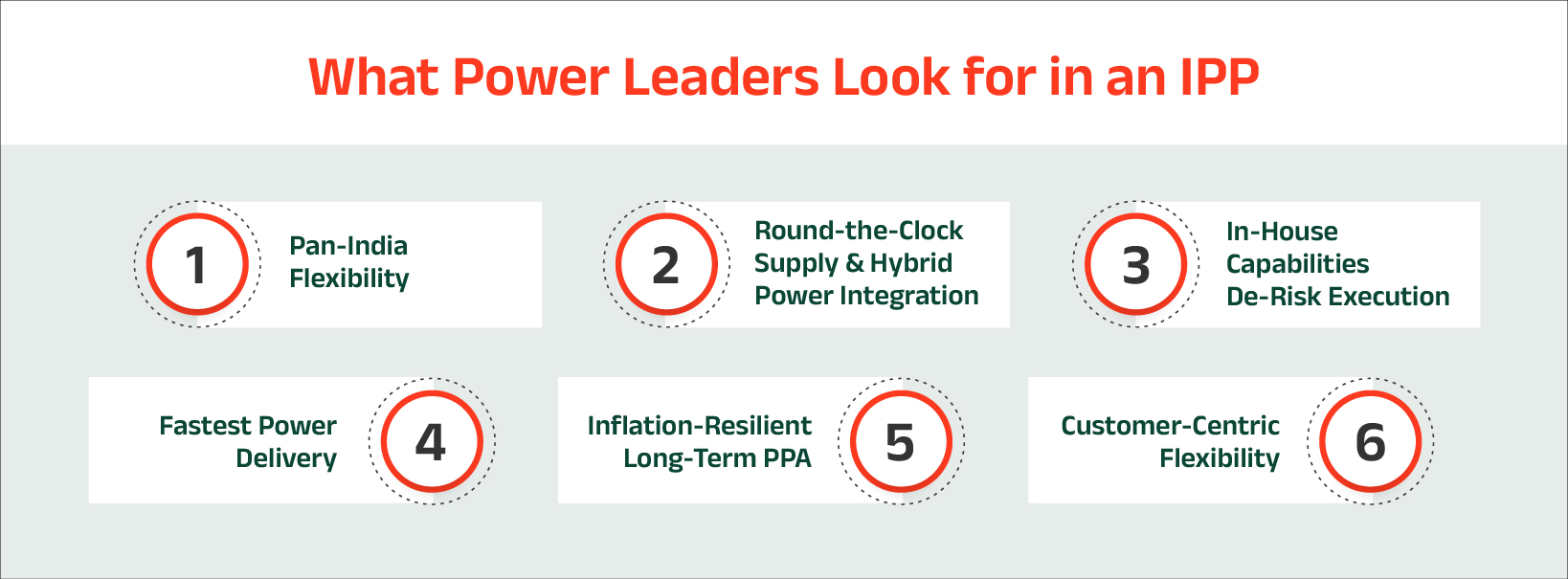
Pan-India Flexibility Choosing an IPP with both intrastate and interstate project capabilities ensures access to the most cost-efficient RE corridors across India. This flexibility lowers landed cost and hedges against future grid constraints.
Round-the-Clock Supply & Hybrid Power Integration With grid demand peaking across day and night cycles, RTC power is no longer a luxury—it’s a necessity. IPPs that offer hybrid RE portfolios (solar + wind + storage) can help you displace the largest share of grid power, pushing your RE penetration toward 80–90%.
In-House Capabilities De-Risk Execution IPPs with internal capabilities across project development, financing, regulatory, and O&M drastically reduce execution risk. You avoid fragmented vendors, delays, and compliance lapses—which directly translates to faster commissioning and fewer liabilities.
Fastest Power Delivery The faster your plant is commissioned, the sooner you start saving. A best-in-class IPP can activate supply in 4–6 months versus 10+ months for less experienced developers. That’s millions saved in avoided grid tariffs and diesel backup.
Inflation-Resilient Long-Term PPA Signing a 15–25 year PPA at a fixed tariff shields your business from tariff hikes, fossil fuel volatility, and shifting state regulations. Energy becomes a predictable OPEX, not a variable cost center.
Customer-Centric Flexibility The right IPP is more than a supplier – they become a business’ strategic energy partner. Look for one that tailors project structure, location, PPA complexities, and hybrid mix to your exact operational needs.
A Group Captive Power Plant helps reduce electricity costs by allowing multiple businesses to share the investment and operational expenses. By owning at least 26% of the project, they benefit from lower tariffs and exemptions from cross-subsidy and additional surcharges which leads to guaranteed savings compared to grid power.
Yes, renewable energy can be used in both Captive and Group Captive Power Plants. Owners can incorporate solar, wind, or other renewable sources depending on availability and cost-effectiveness. Using renewable energy helps reduce the carbon footprint and energy costs and provides an environmentally friendly power solution.
Industries benefit from shifting to a Group Captive Solar Power Plant by reducing electricity costs, as they share investment and operational expenses. They also gain exemption from cross-subsidy and additional surcharges and enjoy guaranteed savings with lower tariff rates, all while supporting sustainable energy solutions.
In India, captive power plant owners can benefit from government subsidies, tax exemptions, accelerated depreciation, and investment tax credits. Additional incentives include net metering, feed-in tariffs, renewable energy certificates, and low-interest loans, all aimed at reducing costs and encouraging clean energy use.
Industries transition from grid power to captive power by first assessing their energy needs. They then invest in their power plants, such as generators or renewable sources. This helps them control costs, ensure a reliable supply, and reduce dependence on the grid. Proper planning and installation are essential for a smooth switch.